> For the complete documentation index, see [llms.txt](https://docs.onelens.cloud/llms.txt). Markdown versions of documentation pages are available by appending `.md` to page URLs; this page is available as [Markdown](https://docs.onelens.cloud/automate/remediations/runbooks.md).
# Runbooks
Runbooks let you take quick, automated actions to optimize resources in your AWS accounts based on cost-saving opportunity tickets. These scripts are triggered from the OneLens UI and help you resolve issues flagged by policy violations with minimal manual effort.
## How Runbooks Work
Each runbook is a script designed to fix a specific issue in your AWS environment. Once you install a runbook in your account, you can trigger it whenever needed.
Here’s what happens when you run one:
1. You trigger the runbook—usually from a ticket in OneLens.
2. OneLens sends the request to the change manager in your account.
3. The change manager runs the script step by step and applies the fix.
{% hint style="warning" %}
## **Access Scope**
OneLens itself does **not** have permissions to perform actions defined in runbooks. All execution is handled within your account by the [Change Manager](https://docs.aws.amazon.com/systems-manager/latest/userguide/change-manager.html).
Change Manager, a tool in AWS Systems Manager, is an **enterprise change management framework** for requesting, approving, implementing, and reporting on operational changes to your application configuration and infrastructure.
With Change Manager, you can use **pre-approved *****change templates*** to help automate change processes for your resources and help avoid unintentional results when making operational changes.
Runbooks are **battle tested** and use only **the minimal permissions** required to make the intended changes and remain confined to your environment.
{% endhint %}
## Finding the Right Runbook
To access the Runbook page:
1. Log in to the OneLens UI.
2. Open the Runbook section from the left sidebar.
You’ll see a page like the one below, with key controls highlighted:
Number References
1. [Search Box](#search)
2. [Filter By Risk](#risk)
3. [Filter By Operation](#operation)
4. [Filter By Service](#service)
### Search
Use the search bar to quickly find Runbooks by name or keyword.
### Filters
Use filters to quickly find the right runbook based on what you're trying to resolvez;
#### **Risk**
Select the runbooks based on the severity of the issue they address:
1. **Low**: For low-impact fixes
2. **Medium**: For moderately actions
3. **High**: For critical remediations
#### **Operation**
Filter runbooks by the kind of change they make:
1. Creation
2. Updation
3. Deletion
#### **Service**
Select the runbooks based on the service. Following are the services available:
* CloudWatch, EBS, EC2, ElastiCache, Elastic Load Balancing, IAM, RDS, VPC
{% hint style="success" %}
For a complete list of available Runbooks along with their details, visit the [Runbook Catalogs](/automate/remediations/runbooks/runbook-catalog.md) page.
{% endhint %}
## Installing a Runbook
To install a runbook in one of your accounts, follow the steps in the [runbook Installation](/automate/remediations/runbooks/install-runbooks.md) guide.
## Executing a Runbook
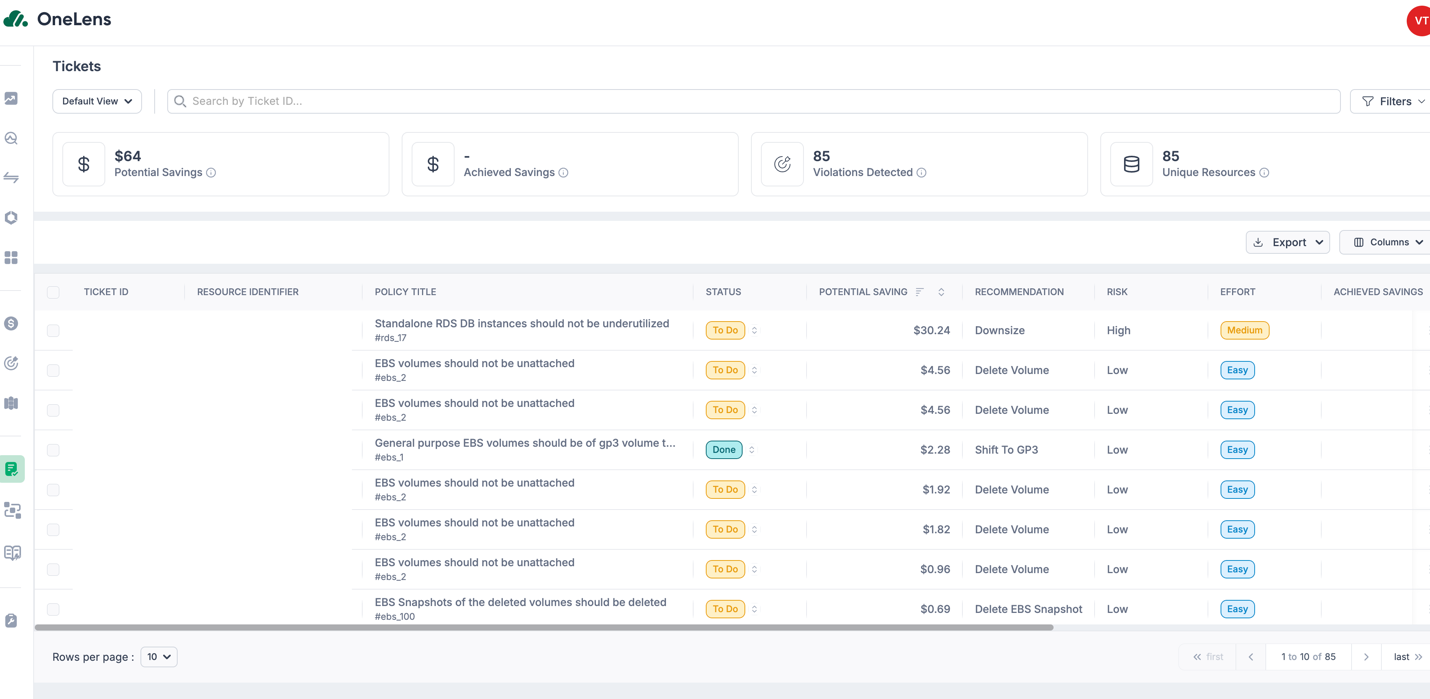
You trigger a runbook directly from a ticket.
{% hint style="warning" %}
## Prerequisite
Make sure the runbook is already installed in the account tied to the ticket.
{% endhint %}
{% stepper %}
{% step %}
Go to the **Tickets** page.
{% endstep %}
{% step %}
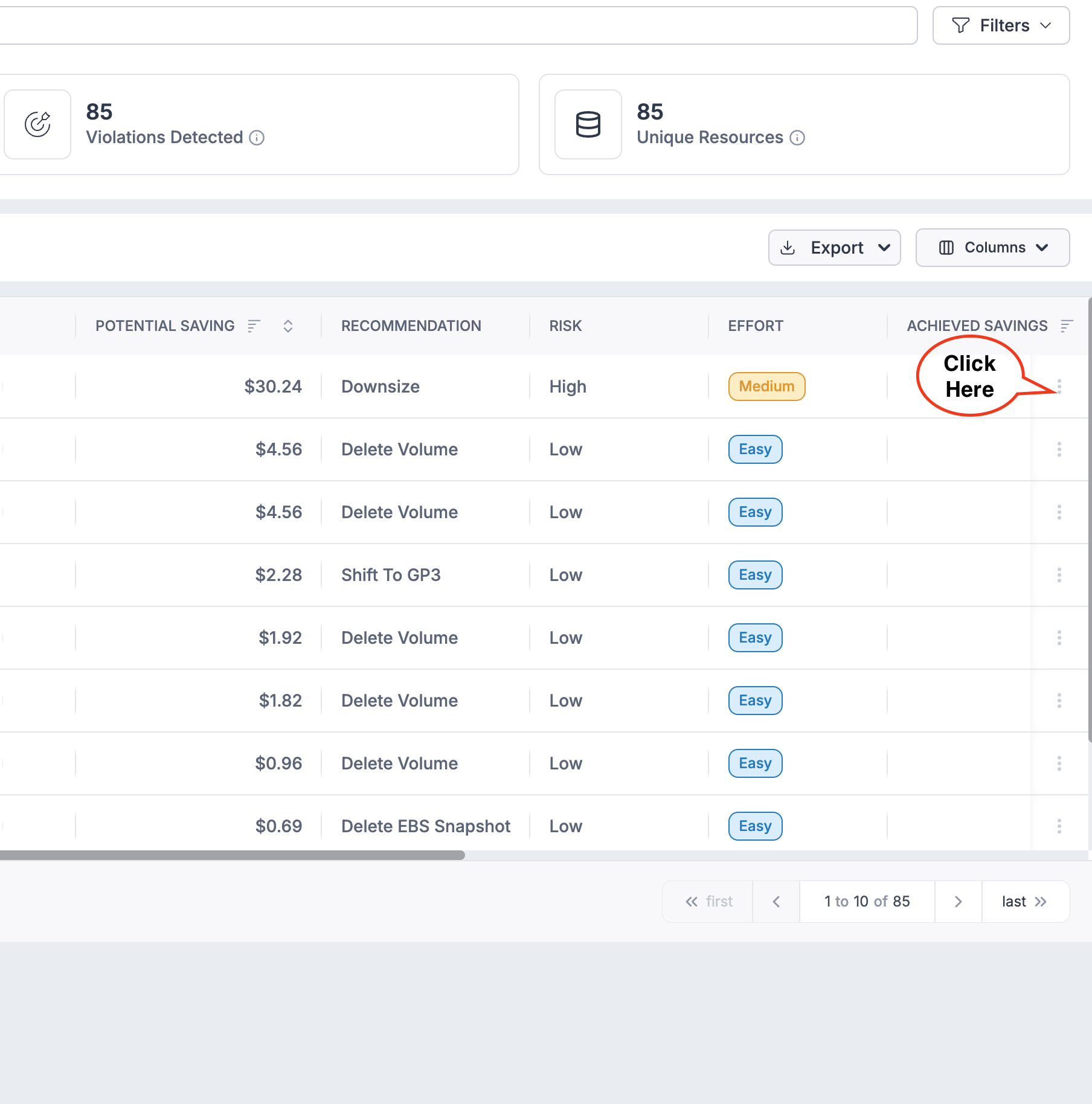
Click the three-dot menu on the right side of the ticket.
{% endstep %}
{% step %}
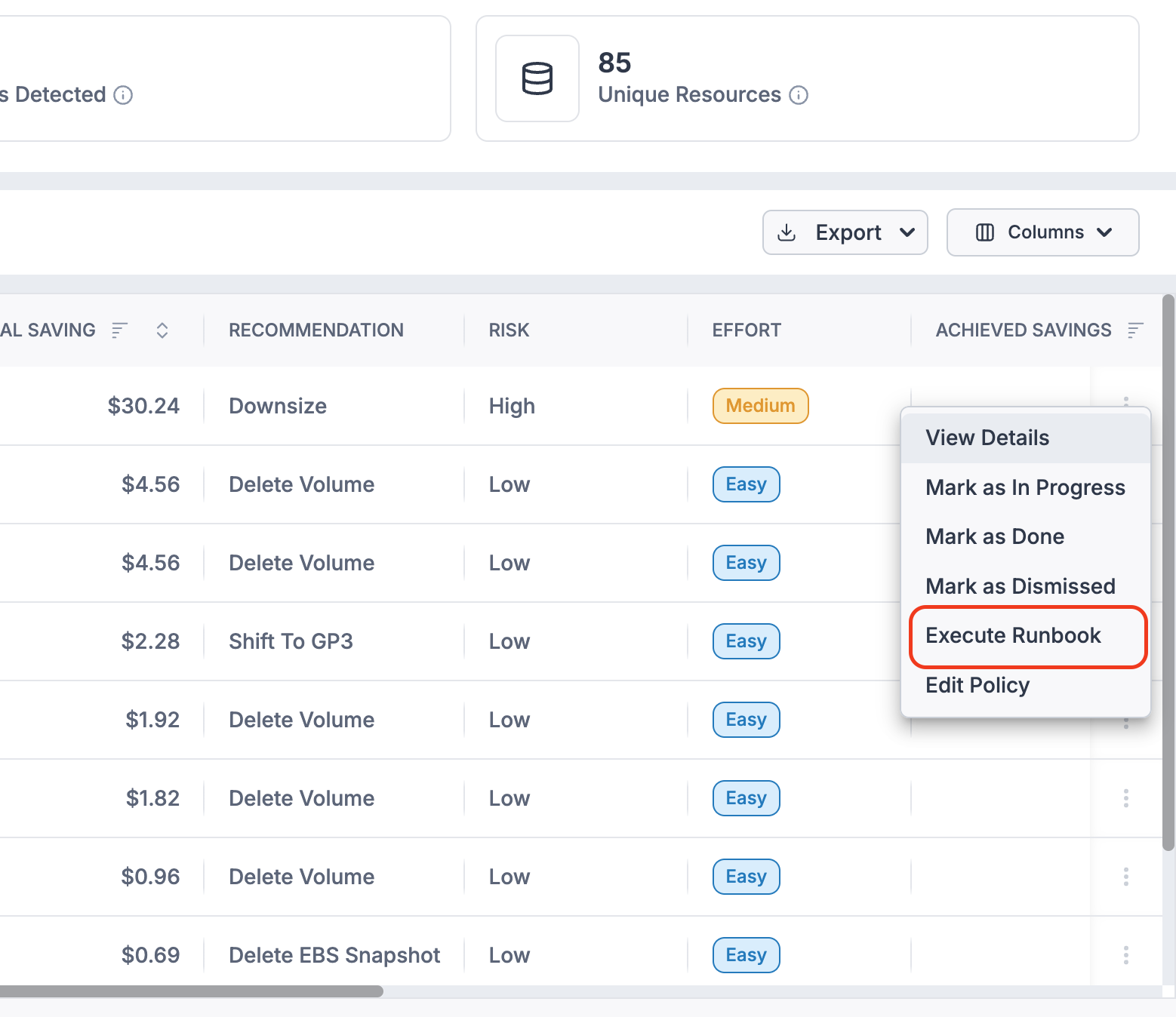
Choose **Execute Runbook**.
{% endstep %}
{% step %}
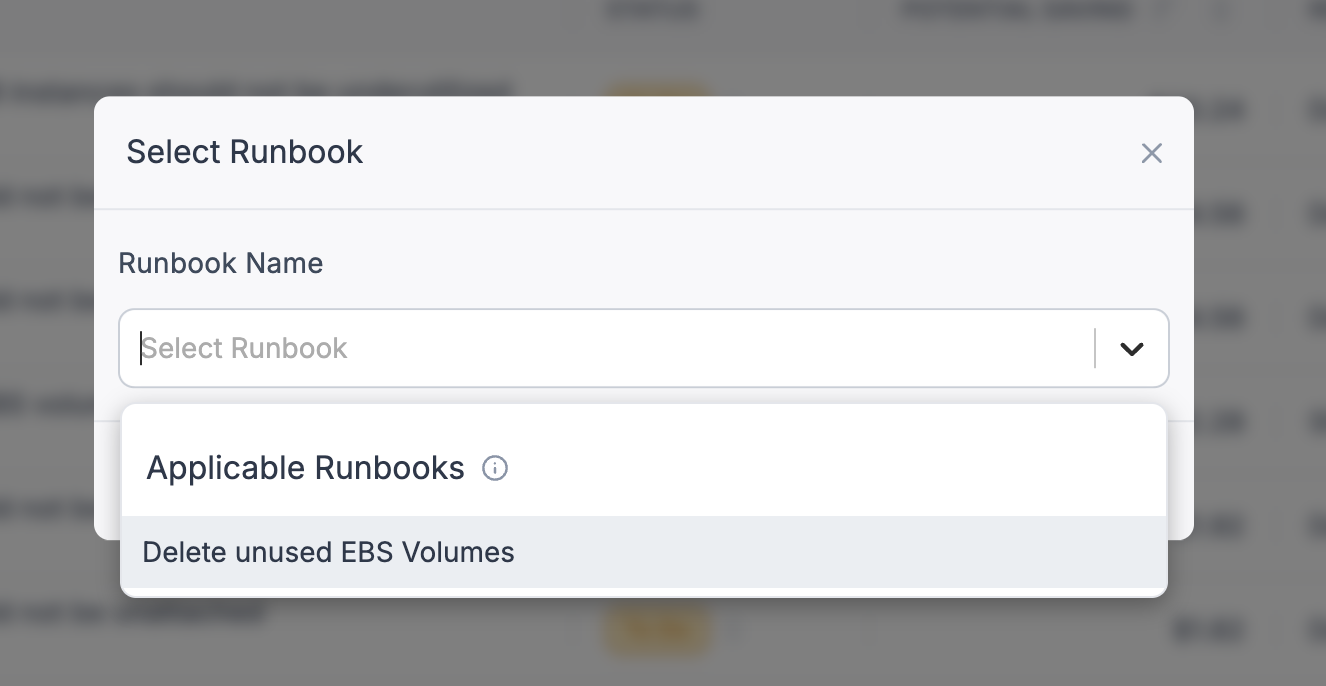
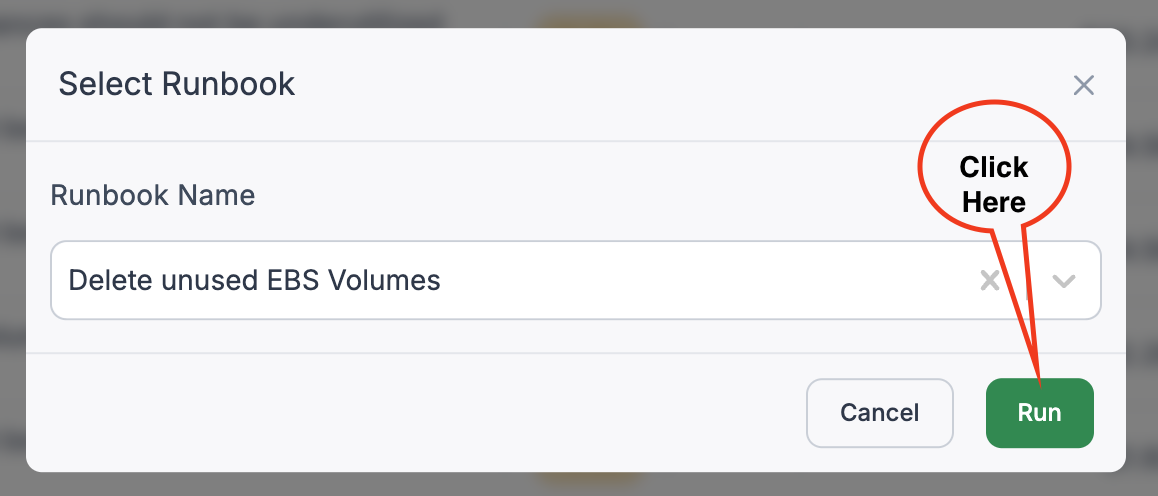
Pick the runbook you want to run.
{% endstep %}
{% step %}
Click **Run** to start the runbook execution.
{% endstep %}
{% endstepper %}
{% hint style="info" %}
## Bulk Runbook Execution
You can also **bulk-execute** runbooks on multiple tickets at once.\
For example, if you want to delete unused EBS volumes in a production account:
* In the **Tickets** section, apply filters like **Account ID = Production Account Name**, **Service = EBS**, and **Change Type = Decommissioning**
* Select all the matching ticket rows.
* Click on **Bulk Action.**
* Choose **Execute Runbook.**
* Pick the desired runbook and execute it across all selected tickets.
{% endhint %}
The execution will take some time to complete. You can track the execution status and view logs in the [**Execution** **log**](/automate/remediations/runbooks/execution-logs.md) page.
---
# Agent Instructions
This documentation is published with GitBook. GitBook is the documentation platform designed so that both humans and AI agents can read, navigate, and reason over technical content effectively. Learn more at gitbook.com.
## Querying This Documentation
If you need additional information that is not directly available in this page, you can query the documentation dynamically by asking a question.
Perform an HTTP GET request on the current page URL with the `ask` query parameter, and the optional `goal` query parameter:
```
GET https://docs.onelens.cloud/automate/remediations/runbooks.md?ask=&goal=
```
`ask` is the immediate question: it should be specific, self-contained, and written in natural language.
`goal` is optional and describes the broader end goal you are ultimately trying to accomplish on behalf of the user. GitBook uses it to tailor the answer towards what is most useful for that goal.
The response will contain a direct answer to the question and relevant excerpts and sources from the documentation.
Use this mechanism when the answer is not explicitly present in the current page, you need clarification or additional context, or you want to retrieve related documentation sections.

 {% endstep %}
{% step %}
Click the three-dot menu on the right side of the ticket.
{% endstep %}
{% step %}
Click the three-dot menu on the right side of the ticket.
 {% endstep %}
{% step %}
Choose **Execute Runbook**.
{% endstep %}
{% step %}
Choose **Execute Runbook**.
 {% endstep %}
{% step %}
Pick the runbook you want to run.
{% endstep %}
{% step %}
Pick the runbook you want to run.
 {% endstep %}
{% step %}
Click **Run** to start the runbook execution.
{% endstep %}
{% step %}
Click **Run** to start the runbook execution.
 {% endstep %}
{% endstepper %}
{% hint style="info" %}
## Bulk Runbook Execution
You can also **bulk-execute** runbooks on multiple tickets at once.\
For example, if you want to delete unused EBS volumes in a production account:
* In the **Tickets** section, apply filters like **Account ID = Production Account Name**, **Service = EBS**, and **Change Type = Decommissioning**
* Select all the matching ticket rows.
* Click on **Bulk Action.**
* Choose **Execute Runbook.**
* Pick the desired runbook and execute it across all selected tickets.
{% endstep %}
{% endstepper %}
{% hint style="info" %}
## Bulk Runbook Execution
You can also **bulk-execute** runbooks on multiple tickets at once.\
For example, if you want to delete unused EBS volumes in a production account:
* In the **Tickets** section, apply filters like **Account ID = Production Account Name**, **Service = EBS**, and **Change Type = Decommissioning**
* Select all the matching ticket rows.
* Click on **Bulk Action.**
* Choose **Execute Runbook.**
* Pick the desired runbook and execute it across all selected tickets.
