> For the complete documentation index, see [llms.txt](https://docs.onelens.cloud/llms.txt). Markdown versions of documentation pages are available by appending `.md` to page URLs; this page is available as [Markdown](https://docs.onelens.cloud/optimize-cost-savings-and-recommendations/s3-optimization/s3-insights.md).
# S3 Insights
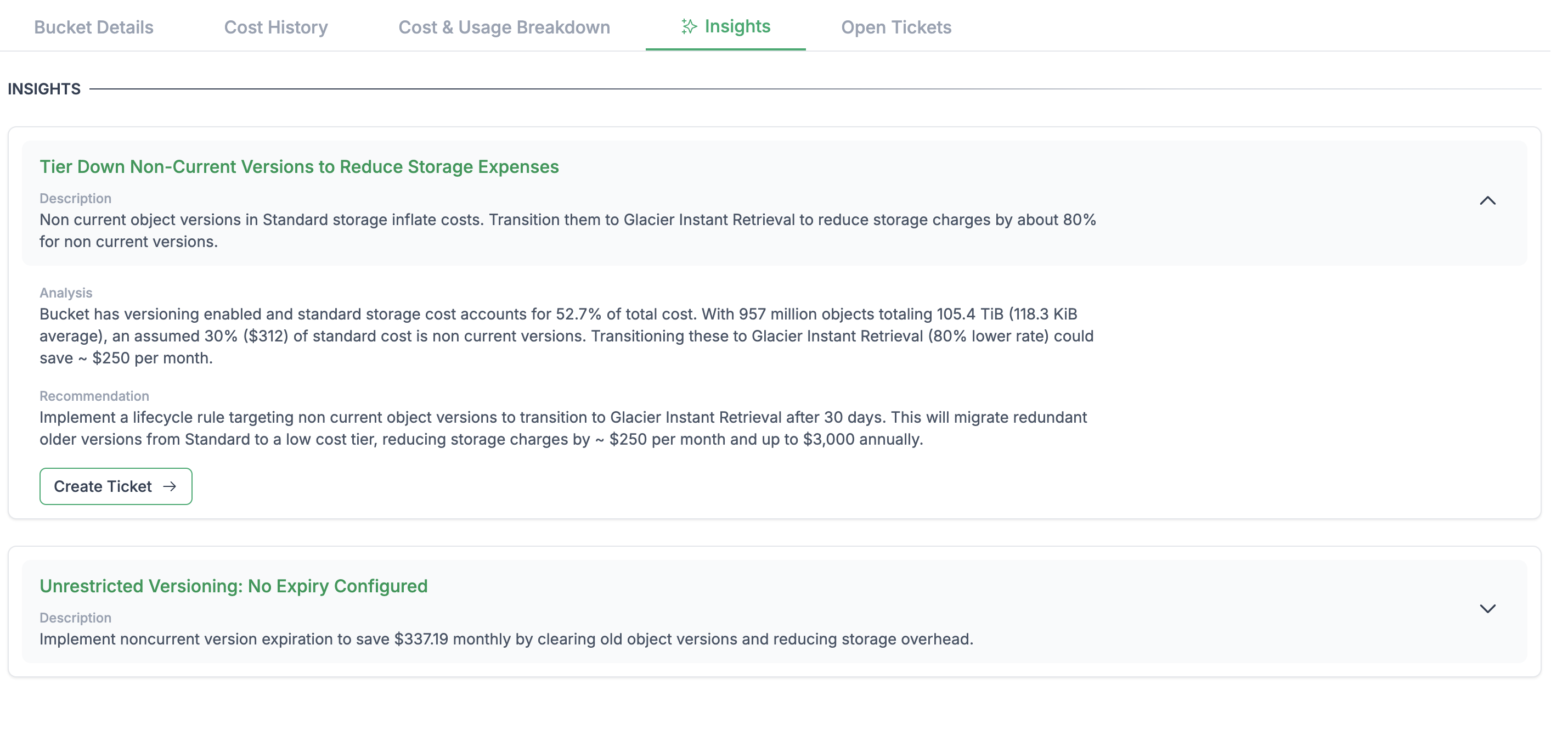
The **Insights** page identifies cost-saving opportunities for your S3 bucket. Insights are generated dynamically based on your bucket’s current setup and usage patterns. Only relevant insights are shown — so what you see is tailored to your buckets configuration.
### What You’ll See for Each Insight
Each insight provides:
* **Description**\
A **concise summary** of the configuration issue and the opportunity detected.
* **Analysis**\
A **data-backed explanation** of why the issue exists and how it affects cost.
* **Recommendation**\
A **suggested action** to optimize your bucket configuration and reduce costs.
* **Benefits** *(optional)*\
Some insights include a **Benefits** section outlining the potential impact of following the recommendation — **such as estimated savings**.
* **Create Ticket**\
If you want to take action, click **Create Ticket** to open a ticket creation form with several fields already prefilled for your convenience.
Further, Learn more about creating a ticket.
### Types of Insights You May Encounter
OneLens analyzes several best practices and inefficiencies. Depending on your configuration, you may see insights such as:
* **Inefficient Lifecycle Policies Driving Up Transition Costs**
* **Excessive Primary Storage Expenses**
* **Excessive Data Retrieval Expenses**
* **Surging Write Activity Charges**
* **Unrestricted Versioning: No Expiry Configured**
* **Surging Outbound Data Transfer Costs**
* **Consider Expiry on Incomplete Multipart Uploads**
* **Tier Down Non-Current Versions to Reduce Storage Expenses**
* **Reactivate the Inactive Lifecycle Policy to Reduce Costs**
* **The Charges for List Requests Are Steep**
Insights are refreshed daily based on the most recent data from your bucket. You can act on any recommendation immediately using the **Create Ticket** option provided on each insight card.
---
# Agent Instructions
This documentation is published with GitBook. GitBook is the documentation platform designed so that both humans and AI agents can read, navigate, and reason over technical content effectively. Learn more at gitbook.com.
## Querying This Documentation
If you need additional information that is not directly available in this page, you can query the documentation dynamically by asking a question.
Perform an HTTP GET request on the current page URL with the `ask` query parameter, and the optional `goal` query parameter:
```
GET https://docs.onelens.cloud/optimize-cost-savings-and-recommendations/s3-optimization/s3-insights.md?ask=&goal=
```
`ask` is the immediate question: it should be specific, self-contained, and written in natural language.
`goal` is optional and describes the broader end goal you are ultimately trying to accomplish on behalf of the user. GitBook uses it to tailor the answer towards what is most useful for that goal.
The response will contain a direct answer to the question and relevant excerpts and sources from the documentation.
Use this mechanism when the answer is not explicitly present in the current page, you need clarification or additional context, or you want to retrieve related documentation sections.